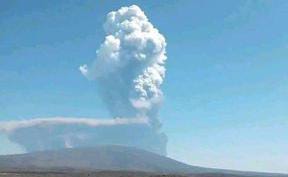
Ethiopia’s Hayli Gubbi volcano, dormant for over 12,000 years, erupted recently for the first time in recorded history, releasing a massive ash plume rising up to 10–15 km into the atmosphere. The drifting volcanic ash began entering parts of western and northern India, prompting airlines and airport authorities to issue precautionary advisories for passengers. The eruption has also disrupted segments of West Asian airspace and may affect select international routes due to altered flight paths and reduced visibility.
About the Hayli Gubbi Volcano
- The Hayli Gubbi is a remote shield volcano located in Ethiopia’s Afar Region and forms the southernmost section of the Erta Ale volcanic range.
- Sitting at an elevation of about 493 metres, the volcano had no confirmed eruptions during the last 10,000–12,000 years.
- On 23 November 2025, it produced a powerful explosive eruption detected primarily through satellite monitoring, releasing significant amounts of sulfur dioxide. The resulting ash cloud travelled across the Red Sea into Oman, Yemen, Iran, Pakistan, and India.
- The eruption was driven by tectonic stretching, accumulating magma, trapped gases, and a long-sealed volcanic system beneath the Afar Rift, a region where the African, Somali, and Arabian plates are pulling apart.
- Over time, rising magma increased internal pressure until the crustal seal broke, leading to a sudden, gas-rich explosive eruption. The tall ash column indicates the presence of high gas content in the magma, typical of eruptions following long dormancy.
Impact on air quality in India
- The eruption’s plume entered fast-moving upper-level wind currents, similar to the jet stream. These winds transported the ash eastward across the Arabian Peninsula and into India. By late Monday, the ash plume was reported over Gujarat, Rajasthan, northwest Maharashtra, Delhi, Haryana, and Punjab, travelling at 100–120 km/h at altitudes between 15,000 and 45,000 ft.
- The ash cloud is unlikely to worsen air quality at the surface level because it remains confined to higher altitudes. Some regions may experience temporary haze or dimming of sunlight as the plume continues to drift and dilute.