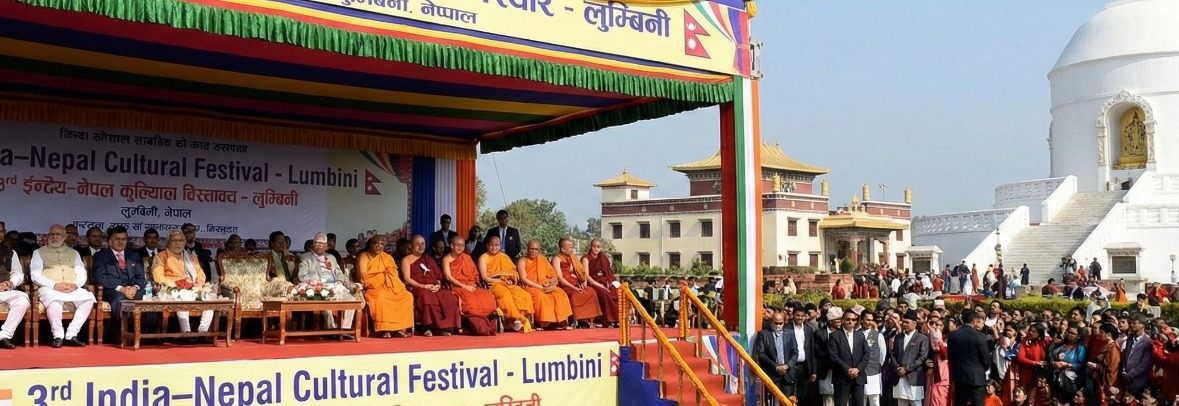
The third edition of the India–Nepal Cultural Festival commenced today in Lumbini, jointly organised by the Embassy of India in Kathmandu, ICCR, and Lumbini Buddhist University. Lumbini stands as a powerful symbol of the deep civilisational, spiritual, and cultural bonds between the two nations, forming part of a broader Buddhist heritage that also connects Bodh Gaya, Sarnath, and Kushinagar.
Key points
- A special symposium has been convened to honour this shared Buddhist legacy as a core pillar of India–Nepal friendship, strengthening people-to-people ties and reaffirming a common vision grounded in the values of Metta, Shanti, Karuna, and Dharma.
- Serving as a platform for scholarly dialogue, the academic symposium deepens cultural understanding and reinforces a timeless relationship rooted in history.
- The enduring Buddhist heritage between India and Nepal represents a living philosophy that has shaped global ideals of peace and compassion.
- The historic pilgrimage of Emperor Ashoka in 249 BCE to sites associated with the Buddha exemplifies the ancient cross-border spiritual diplomacy that continues to guide bilateral engagement today.
About the Significance of Lumbini
- Lumbini, located in present-day Nepal, revered as the birthplace of Buddha. It holds immense historical, spiritual, and cultural significance as the birthplace of Lord Buddha. Recognised as a UNESCO World Heritage Site, it is one of the most revered pilgrimage destinations for Buddhists worldwide.
- The site encompasses sacred monuments, ancient monasteries, the Maya Devi Temple, and Ashokan pillars that commemorate Emperor Ashoka’s visit in 249 BCE, reflecting the region’s enduring connection to Buddhist history and philosophy.
- Lumbini is not only a symbol of spiritual awakening and peace but also serves as a living testament to India–Nepal civilisational ties, representing shared values of compassion, harmony, and non-violence.
- Beyond its religious importance, Lumbini has become a centre for cultural exchange, scholarly research, and tourism, reinforcing its role as a bridge between ancient heritage and contemporary global engagement.
- Its significance lies in both its historical legacy and its ongoing contribution to promoting international dialogue on peace and cultural understanding.