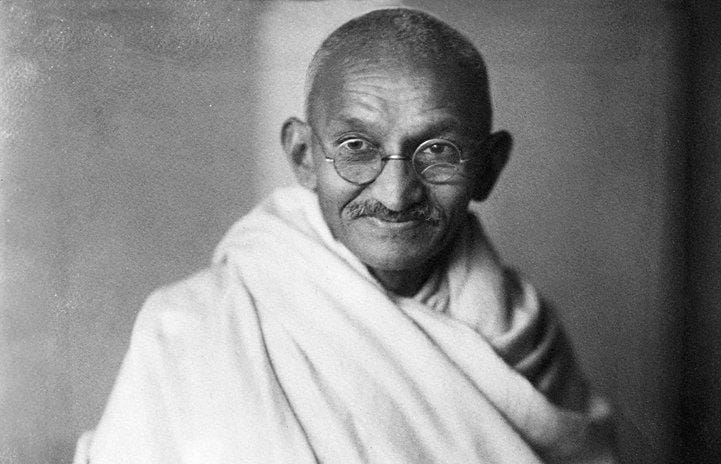
Every year on 30 January, India pauses to remember Mahatma Gandhi—not merely to mourn his assassination, but to reflect on the values he lived and died for. Gandhi was not just a leader of India’s freedom movement; he was a moral force who attempted to answer one of humanity’s most difficult questions: How should power be exercised without losing one’s soul?
In an age marked by anger, inequality, ecological crisis, and moral confusion, Gandhi’s life principles feel less like history and more like a mirror held up to our present.
Truth as a Way of Life
For Gandhi, Satya (truth) was not a convenient tool but a lifelong discipline. Truth, in his understanding, was inseparable from honesty in thought, speech, and action. He believed that truth had transformative power—not only politically, but personally. One could not claim to seek truth while nurturing hatred, arrogance, or deception.
In today’s world of misinformation, curated realities, and viral falsehoods, Gandhi’s insistence on truth is profoundly relevant. Social media rewards speed over accuracy, outrage over reflection.
Gandhi reminds us that truth demands patience and courage. It requires us to listen before reacting, verify before sharing, and introspect before accusing. Truth, for him, was not about winning debates but about aligning one’s inner self with moral clarity.

Non-Violence Beyond the Absence of Force
Ahimsa, or non-violence, is often misunderstood as weakness or passivity. Gandhi rejected this interpretation completely. For him, non-violence was an active, fearless resistance to injustice. It demanded greater strength than violence because it required self-control, empathy, and moral conviction even in the face of provocation.
In an era where violence has taken new forms—verbal abuse, online harassment, political polarisation, and economic exploitation—Gandhi’s concept of non-violence expands beyond physical harm. It asks us to consider: Are our words violent? Are our policies violent? Are our systems violent in how they exclude, marginalise, or silence?
Non-violence today means resisting hate without becoming hateful. It means opposing injustice without dehumanising opponents. It is deeply relevant in societies struggling with ideological divides, reminding us that lasting peace cannot be built on humiliation or fear.
Ends and Means: The Moral Compass
One of Gandhi’s most radical assertions was that means are as important as ends. He rejected the idea that noble goals justify unethical methods. Freedom achieved through violence, deceit, or oppression would inevitably reproduce the same evils it sought to eliminate.
This principle challenges modern politics, business, and even activism, where shortcuts are often rationalised in the name of efficiency or urgency. Gandhi’s life urges us to ask uncomfortable questions: Can corruption produce development? Can hate speech strengthen democracy? Can exploitation create prosperity?
In a world obsessed with outcomes—profits, votes, influence—Gandhi reminds us that methods shape character, and character shapes society. Ethical compromises, even when successful in the short term, corrode institutions and trust in the long run.

Simplicity in an Age of Excess
Gandhi lived simply, not as an aesthetic choice but as a moral statement. He believed that excessive consumption by a few inevitably resulted in deprivation for many. His famous warning—that the Earth has enough for everyone’s need but not for everyone’s greed—sounds prophetic in today’s climate crisis.
Modern society equates success with accumulation. Gandhi inverted this logic, arguing that restraint was the foundation of justice. In the context of environmental degradation, widening inequality, and unsustainable lifestyles, his emphasis on simplicity and self-restraint is urgently relevant.
Sustainability today is not merely a technological challenge; it is a moral one. Gandhi would argue that without changing our desires, no amount of innovation can save us. His life invites individuals and nations alike to rethink progress—not as endless growth, but as balanced well-being.
Fearlessness and Moral Courage
Gandhi’s courage did not come from physical strength or authority but from moral clarity. He was willing to stand alone, to be misunderstood, criticised, and even opposed by those closest to him. Yet he remained open to self-correction, publicly admitting mistakes when he believed he had erred.
In a time when public life often rewards conformity and punishes dissent, Gandhi’s fearlessness is instructive. He teaches us that courage is not loud aggression but quiet conviction. It is the ability to stand by principles even when they are inconvenient.
For young people navigating career pressures, social expectations, and ethical dilemmas, Gandhi’s life offers a powerful lesson: integrity may not guarantee immediate success, but it ensures inner freedom—and that is a form of success no external force can take away.

Leadership as Service
Gandhi redefined leadership as service (seva). He did not seek power for its own sake and consistently resisted being placed on a pedestal. He believed that leaders must remain accountable to the poorest and most vulnerable.
Today, when leadership is often associated with privilege, spectacle, and distance from ordinary lives, Gandhi’s model feels revolutionary. Whether in politics, corporate life, or civil society, his example challenges leaders to ask: Whom do I serve? Whose voice am I amplifying? Who is missing from the room?
True leadership, Gandhi reminds us, is not about commanding obedience but inspiring trust. It flows not from authority alone, but from moral example.
A Legacy That Demands Action
Remembering Mahatma Gandhi is not about ritual or reverence alone. It is about responsibility. His principles are demanding precisely because they require self-examination. They do not allow us to outsource morality to institutions or leaders; they insist that change begins with the individual.
In today’s turbulent world—marked by conflict, climate anxiety, economic uncertainty, and social fragmentation—Gandhi does not offer easy solutions. He offers something more enduring: a moral framework rooted in dignity, compassion, and courage.
On his death anniversary, perhaps the most meaningful tribute is not a garland or a speech, but a question each of us must answer: How can I live more truthfully, more non-violently, and more responsibly in my own sphere of influence? Gandhi’s life assures us that even in the darkest times, ethical action is not futile. It is, in fact, the only path to a just and humane future.